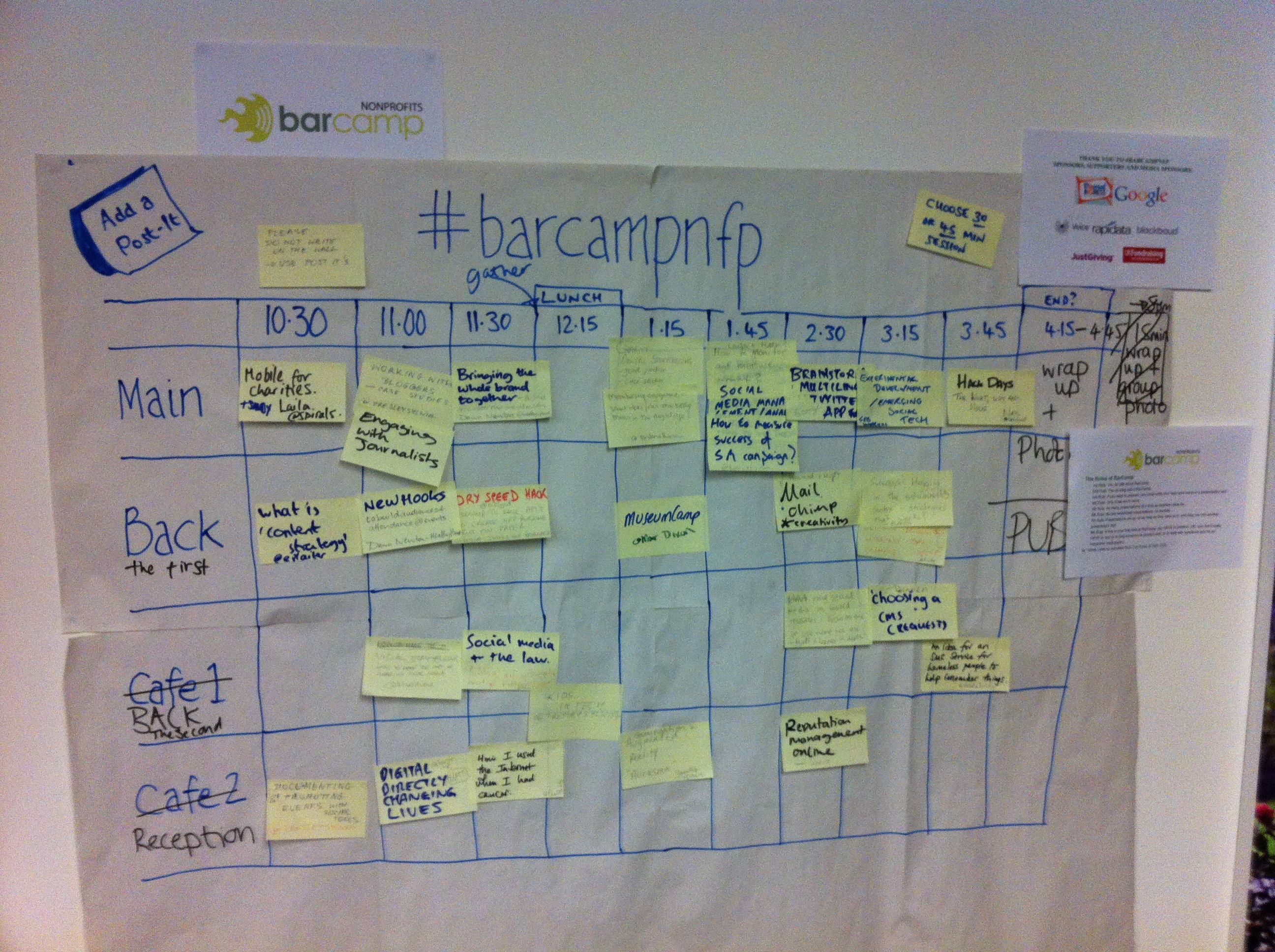
The night before barcampnfp

barcampnfp Oct 2012I’ve been involved in barcampnfp for about a year and a half now, once as a helper and twice as the London lead organiser. Every time I learn something new, or more accurately, lots of new things.

There’s something special about an unconference format which means you learn something every time no matter whether you’re a newbie or old hand. Often it’s something I didn’t even know I wasn’t aware of. That’s why I’m really excited about tomorrow, not for what I know is going to happen but what I don’t know.

We’ve got some brilliant people on the participants list and lots of plotting of ideas for sessions already happening on the hashtag.

Watch this space #barcampnfp and hopefully our live notes will work too: bit.ly/bcnfpnotes

barcamp non-profits october 2012

Last week was the second London Barcampnfp. As one of the co-organisers I don’t want to say too much as a few of our lovely participants have already done a much better job than I would:

[I’ll keep adding to this list as new posts appear]

My key take-out is; get the right people together and wonderful ideas are inevitable. But we need even more people, including more non-charity people as well next time!

So please spread the word, February 2013 here we come…

what does a digital first organisation look like?

I often mull over whether my digital transformation work will ever been done (in a good way), and what it will look like when we get there. I was thinking this over while scanning through a e-consultancy report on the evolution of agencies. There were a couple of role descriptions which I think go some way to painting a picture of digital first organisation structures:

‘T-shaped’ people
“staff who have a strong, vertical digital skill, but have either a breadth of experience outside of this vertical area or at least a useful level of understanding and empathy with other vertical digital channels and, notably, with traditional marketing practice and techniques.”

Chief creative technologist (More on this theme in the excellent chiefmartec blog)
“The three main areas of focus for the role are:
1. Helping the Chief Marketing Officer translate strategy into technology and vice versa
2. Choreographing data and technology across the marketing organisation
3. Infusing technology into the DNA of marketing – practices, people and culture”

I’m still undecided whether digital teams will cease to exist entirely. I certainly think there will be fewer titles with ‘digital’, ‘web’ or ‘online’ within them. Like the descriptions above, digital and non-digital staff will have more rounded skills-sets all around.

the future of digital giving

This week I was one of a few charity and digital industry types at a roundtable discussion on the future of giving technology hosted by the Guardian. It’ll be written up by the Guardian as an article in mid-May but while my memory is still fresh I wanted to capture a few of my personal take-outs.

  • Technology adoption by charities:
    • Charities are behind the curve in contrast to commercial, partly due to expense of adopting the new while its less consumerised and partly because the technology expertise is missing in many charities.
    • There’s also the technology industry view that the charity sector doesn’t have a strong business case for investment (see previous post by me on Spring-giving).
  • Innovation in charity sector:
    • Some interesting models exist but often innovation comes from the ground up, but only where those ground staff are empowered to express their ideas.
    • In smaller charities the silos that stifle innovation don’t exist (mostly).
  • Giving trends:
    • There’s a question over whether digital channels are fund-catching Vs fundraising.
    • No charity wants to swap a channel which has a higher average gift for one with a lower average gift so sometimes a more convenient channel is a less effective one for the charity.
    • We need to separate the process from the reason, people don’t give because you have an SMS number they give because of the cause and key messages.
  • Some insights from experiences shared:
    • SMS giving has meant a lower average gift for certain charities, choosing ‘slumps’ as focus point for using SMS calls to action is a good mitigation.
    • Unexpected ‘social media’ response as seen with the tragic case of Claire Squires mostly demonstrate that giving is easier than it was before. They pose speed of response and decision-making challenges.


maximising mobile marketing – @Brandrepublic conference

Last week I attended a conference on maximising mobile marketing. I tweeted. A lot. Here’s the best bits.

  1. #brmobile over 1billion in bets through mobile says @betfair speaker – people using dead time
    November 8, 2011 4:16:01 AM EST
  2. First speaker… Comscore
  3. Mobile handsets – 27% nokia, 11% iphone, Samsung 19% #brmobile
    November 8, 2011 4:20:47 AM EST
  4. 54% of people in the UK don’t have a smartphone #BRMobile
    November 8, 2011 4:22:34 AM EST
  5. 40% consumers use mobile when see an interesting ad – even if not a mobile ad #brmobile
    November 8, 2011 4:28:10 AM EST
  6. November 8, 2011 4:29:20 AM EST
  7. 10% of UK smartphone users (4.7m) accessing mobile banking now #brmobile
    November 8, 2011 4:33:33 AM EST
  8. Don’t forget SMS – it can give significant response 1.9mil out of 19.9mil #brmobile
    November 8, 2011 4:38:58 AM EST
  9. July 2011- 2.9mil scanned a QR code – mostly for product discovery #brmobile
    November 8, 2011 4:40:42 AM EST
  10. Top tips slide 2 #brmobile http://lockerz.com/s/154319556
    November 8, 2011 4:41:50 AM EST
  11. 3 takeaways from comescore-1.Mobile growing rapidly 2.consider carefully the audience you want to reach 3. don’t get left behind #brmobile
    November 8, 2011 4:44:22 AM EST
  12. Next speaker… Expedia
  13. #brmobile 39% of people use their smartphone whilst on the toilet
    November 8, 2011 5:24:00 AM EST
  14. 80% of apps less than 1000 downloads (consumer healthcare). Less than 1% branded apps pass 1mill downloads #brmobile (Deloitte research)
    November 8, 2011 4:57:01 AM EST
  15. . @expedia decided not to silo mobile with a specific mobile person. Had mobile champions but integrated into core business #brmobile
    November 8, 2011 5:17:44 AM EST
  16. 4mil monthly mobile visitors to @expedia mobile, and it’s not cannabalising website bookings #brmobile
    November 8, 2011 5:33:18 AM EST
  17. Top tips for creating a mobile experience from @expedia #brmobile http://lockerz.com/s/154325602
    November 8, 2011 5:32:20 AM EST
  18. Community/ gaming layer, local immediacy layer, social layer, self-service layer – the components of @expedia mobile experience #brmobile
    November 8, 2011 5:30:31 AM EST
  19. Next speaker… Weber Shandwick
  20. Intent vs Content: @jamesdotwarren discusses the results of WS’s #smartmarketing report at #MaximisingMobileMarketing conference #brmobile
    November 8, 2011 5:34:12 AM EST
  21. Mobile mkg = teenage s*x. lots of talk, not much doing, and if doing the doing is not good. #brmobile
    November 8, 2011 5:57:21 AM EST
  22. 44% of people feel naked without their smartphone. 36% changing way think and interact with products and services #brmobile
    November 8, 2011 5:59:49 AM EST
  23. Search lifecycle- desktop 30day journey search to purchase, 1hour on mobile! #brmobile
    November 8, 2011 6:05:51 AM EST
  24. Next speaker… Sky
  25. Sky have over 1m people viewing live tv via mobile devices every month #brmobile #skygo
    November 8, 2011 6:45:02 AM EST
  26. 23% of online time is spent on mobile. If you work in digital you should spend at least this on mobile too #brmobile
    November 8, 2011 6:50:38 AM EST
  27. 3 screen strategy is core @sky. From content build through to advertising – becoming agnostic to a degree #brmobile
    November 8, 2011 6:39:04 AM EST
  28. ‘integrated marketing is the output of an integrated business’ Tim Hussain, Sky #brmobile
    November 8, 2011 6:51:11 AM EST
  29. Ultimately it’s still about single consumer view. Just multiethnic touch points and screens #brmobile
    November 8, 2011 6:41:00 AM EST
  30. Mobile USP to a campaign- it’s personal, it’s a second shadow (always there), it’s immediate, it’s feature rich #brmobile
    November 8, 2011 6:54:30 AM EST
  31. Next speaker… Autotrader
  32. Used 4m mkg strategy- Mindset:test,learn,iterate. Method:awareness,education,trial. Mix:mobile,ATL,partners,autotrader. Msg. #brmobile
    November 8, 2011 7:08:09 AM EST
  33. 0.5mil mobile users in 12 months. Became a new challenge #brmobile
    November 8, 2011 7:16:32 AM EST
  34. Bounce increased by 20% when off season. They hit saturation with their activity. Too much share of voice #brmobile
    November 8, 2011 7:18:29 AM EST
  35. Maturing the mobile strategy from autotrader #brmobile http://lockerz.com/s/154340838
    November 8, 2011 7:20:56 AM EST
  36. 300k year 1, 500k year 2, 1mil year 3, next years target is 2mil mobile users of autotrader #brmobile
    November 8, 2011 7:23:09 AM EST
  37. Next speaker… Pizza Express
  38. Now up- pizza express: In oct 27% of all traffic to pizza express sites came from mobile #brmobile
    November 8, 2011 8:07:36 AM EST
  39. 1000 table bookings a month through mobile #brmobile
    November 8, 2011 8:12:16 AM EST
  40. Optimising for mobile search by creating restaurant pages for local sites. To avoid bouncing people into a location search #brmobile
    November 8, 2011 8:13:57 AM EST
  41. Next up a panel discussion
  42. panel with @nicholascumisky – says don’t forget Nokia is still biggest handset producer #brmobile
    November 8, 2011 9:32:37 AM EST
  43. French connection fail – build an app before a m.site and it didn’t work. So now building one. Doh! They needed proper analytics! #brmobile
    November 8, 2011 9:20:13 AM EST
  44. HTML5 offering new innovations. Yodel mobile working on an interactive ad unit for the reader Kobo #brmobile
    November 8, 2011 9:37:27 AM EST
  45. Unilever lynx case study means they now see mobile as a horizontal not just an add-on. They ask how mobile can extend the story #brmobile
    November 8, 2011 9:44:45 AM EST
  46. 3G vs 4g question is diluted by fact that huge amount of mobile connectivity is via wifi. Cloud is on the rise instead of apps #brmobile
    November 8, 2011 9:49:58 AM EST
  47. By 2015 estimated 1.5bil mobiles will have NFC built in. Perhaps some will be dormant – but it’ll be there #brmobile
    November 8, 2011 9:56:21 AM EST
  48. QR code coming under criticism. Only 1% of phones able to read #brmobile
    November 8, 2011 10:00:43 AM EST
  49. NFC going to compliment QR codes and AR not replace it #brmobile
    November 8, 2011 9:59:52 AM EST
  50. Next speaker… Debenhams
  51. How @debenhams see mobile in their business strategy #brmobile http://lockerz.com/s/154371429
    November 8, 2011 10:08:05 AM EST
  52. mobile providing link between channels as always on @debenhams #brmobile
    November 8, 2011 10:09:59 AM EST
  53. Impressive – @debenhams app paid for itself within 2 weeks #brmobile
    November 8, 2011 10:25:06 AM EST
  54. 700k downloads, £3mil sales, over 1/3 use @debenhams app repeat times #brmobile
    November 8, 2011 10:14:06 AM EST
  55. Use push notifications when people close to store – result in 67% app open #brmobile
    November 8, 2011 10:17:32 AM EST
  56. Next speaker… WWF
  57. Goal to increase fundraising by £1mil so @wwf targeting countries where mobile already surpassed desktop use #brmobile
    November 8, 2011 10:29:24 AM EST
  58. . @wwf sms conversion case study – Austria 2007 #brmobile http://lockerz.com/s/154377697
    November 8, 2011 10:38:14 AM EST
  59. Text num on @wwf street team shirt low rsp but ‘text facing’ good #brmobile < note @UNICEF_uk pic http://lockerz.com/s/154379603 http://lockerz.com/s/154379620
    November 8, 2011 10:45:51 AM EST
  60. Next speaker… FT.com
  61. next up FT.com @spoonerf on user journeys #brmobile
    November 8, 2011 11:12:23 AM EST
  62. Mobile users 20% of FT traffic, 30% page views from mobile. Overall 4mil reg users, 250k subscribers #brmobile
    November 8, 2011 11:17:32 AM EST
  63. 15% of subscriptions direct from mobile. Mobile users twice as likely to consume content at wkds #brmobile
    November 8, 2011 11:19:19 AM EST
  64. Last year FT kept launching apps in response to market. But not sustainable. And then apple changed subscription payment journey #brmobile
    November 8, 2011 11:21:32 AM EST
  65. So took a risk – June launch of HTML5 site – within a week 100k downloads so removed apps from iTunes #brmobile
    November 8, 2011 11:22:45 AM EST
  66. Big marketing benefit – can send people straight to content in web app. Not to an iTunes download page #brmobile
    November 8, 2011 11:24:55 AM EST
  67. Next speaker… Visit Britain
  68. First Mobile @visitbritain app in 2008. Too expensive but learnt. 2009 next app learnt need PR to have app found. #brmobile
    November 8, 2011 11:39:35 AM EST
  69. Found more success by tying in mobile to bigger picture – overall digital and marketing strategy rather than just a silo app #brmobile
    November 8, 2011 11:54:05 AM EST
  70. Love UK @visitbritain app used Facebook places. Users 50% more likely to buy and 20% had bigger basket value #brmobile
    November 8, 2011 11:52:31 AM EST
  71. Last speaker… Barclays
  72. Mobile payments and services @barclays #brmobile http://lockerz.com/s/154395549
    November 8, 2011 11:59:39 AM EST
  73. Big challenge is awareness and education about mobile payment options #brmobile
    November 8, 2011 12:03:49 PM EST
  74. Digital wallet is not just a replacement of physical wallet-bump you phone to share money-identification is key #brmobile
    November 8, 2011 12:10:02 PM EST
  75. Mobile wallet should do more than your usual wallet – @barclays ideas here #brmobile http://lockerz.com/s/154397648
    November 8, 2011 12:09:36 PM EST
  76. Parting thoughts …
  77. Fair to say native apps haven’t fared well at todays #BRMobile conf- scope for them certainly- but mobile internet has more potential
    November 8, 2011 10:11:54 AM EST
  78. #smartmarketing #brmobile ROI anyone? 80% of branded apps get less than 1k downloads
    November 8, 2011 6:57:29 AM EST
  79. Still not sure about NFC. Been talked about for years now #Brmobile
    November 8, 2011 10:11:18 AM EST
  80. Great loyalty case studies on Starbucks and Pizza Express. Shows what can be done with mobile loyalty. #brmobile
    November 8, 2011 7:56:34 AM EST
  81. Very thought provoking day at #brmobile mobile marketing conference. Glad to see we’re not alone in our barriers
    November 8, 2011 1:29:02 PM EST

will digital teams continue to exist?

My recent posts have sparked some real world discussions around two questions:

  • If everyone in the future is ‘just doing digital’ what will digital teams be doing?
  • And, as best posed by Alison Daniels, “the nirvana where everyone is ‘just doing digital’ may come, but what’s the ideal transition digital team?”

I’m going to explore the first question here and dedicate a separate post to the other one (watch this space!).

The easiest way to explore this question is with a definition of what everyone in an organisation ‘just doing digital’ could look like, and identifying some of the questions this creates.

Everyone is ‘just’:

  • creating web content – they’re writing web pages, creating short videos, and posting pictures.
  • using social media – through networks like facebook they’re servicing and attracting customers / supporters, through networks like linkedIn they’re making business connections, and they’re using all types of social media to co-create strategies and products.
  • building websites – they’re using drag and drop online tools to create simple web pages that ‘do stuff’.
  • doing digital marketing – they’re creating (or commissioning) search, affiliate and display advertising campaigns.

So here are the questions:

  • How do you manage the quantity Vs quality balance?
  • How do you prioritise for the greater good rather than individual interests?
  • How do you avoid duplication and cannibalisation where it matters?
  • How do you avoid fragmentation and make integration happen?
  • What if existing off-the-shelf tools don’t do what you need them to do?
  • How do you stop your digital activity looking identikit if you’re ‘just doing’ what everyone is ‘just doing’?
  • How do you keep on top of the next new thing if you’re busy doing the day job?

I see the role of future (and perhaps existing) digital teams is to answer these questions. In fact, stepping back, these questions are not too different from those that marketing teams have worked with for a while. So a logical conclusion might be that digital teams will become the marketing teams of the future.

And so we see the rise of creative marketing technologists – this presentation summarises it nicely.


So what do you think? Are you a future creative marketing technologist?

tales of single sign on

SSO sounds like some sort of distress call. For a time I’m sure a few at BHF probably thought it was. A recent project to develop a single sign on (SSO) approach took quite some time and had it’s up’s and a large number of down’s. But the new BHF community is a testament to collaborative working to overcome issues, it’s also a testament to the value SSO brings.

It all started as a seedling of an idea in 2009 when it became clear to me that a toolbox made up of many different technology platforms was the ideal situation if only we could integrate the user journeys and the data behind the scenes. Why did I think this?

  • Avoiding over reliance on a single partner or platform.
  • Using the best tool for the job (by the time I left BHF we had; Magento for the shop, Drupal for the community and Alterian WCMS for the main site plus many other supporting tools).
  • Cost efficiencies of using out of the box functionality that might exist in one platform but not another.
  • Streamlining user journeys across sites – lessening confusion and drop off.

The first opportunity to use SSO was with Vielife who provided a lifestyle check tool. We implemented a SOAP based one-way sign-in to allow people to take the lifestyle check without having to re-type all their personal details. It took about 10 – 15 working days effort to put in place as Vielife had already built SSO connectivity into their platform – so we only had to create the Alterian WCMS end. It all worked very nicely!

Around a year later we decided to implement a Drupal platform for the new BHF community, with the plan that we would use this as an opportunity to build a standard two-way SSO layer to our technical architecture. This layer being the key to delivering on the ideal multi-platform approach in the future.

Following investigation by the two delivery partners (Sift and Positive Technology) and BHF IT it was decided to use SAML this time around. The core reason for this was the wider compatibility offered that would allow for future integrations (eg Magento). It was a challenging project for many reasons; multiple agencies, open source vs proprietary platforms, differing understanding of requirements, internal team changes and more. But we all learnt a lot along the way and came out with something that is beautifully simple as a product.

Would I do it again? Yes, and whenever I run a tender exercise in future I’ll always ask about examples of the platform in use with SSO (plus API‘s and Web Services) even if I don’t intend to make use of these at first.

I’ve only heard of one other UK charity making use of two-way SSO in their digital work. So if you have any SSO tales please do leave a comment – I’m sure there’s more I could learn!
coping with BHF’s biggest online event

I’ve been reflecting on my last few months at BHF (I’ll be starting @UNICEF_UK on Monday 27 June 2011) and thought I’d share a big learning experience that will stay will me.

There is always a huge spike in bhf.org.uk traffic on the day that standard places are released for the British Heart Foundation London to Brighton Bike Ride. The first year we switched to online applications was 2009 and each year we learnt something new and tried different things to improve the process for our supporters.

In 2011 we tried using a virtual queue system. Unfortunately not everything went to plan and quite a number of people were left waiting for quite a few hours. Applications were getting through – just slower than expected because the queue was being over efficient (like a jobs worthy bouncer). After a few hours of this we decided to switch the queue off completely as we felt it was better to risk the site falling over than continue the frustration for everyone (ourselves included). By this point the traffic had lessened too – meaning we were more confident that the site would be able to cope (it did).

Here are a few entirely personal thoughts about what we learned:

Communications on the day:

  • Use social media and be transparent about the problems – people genuinely had more patience when they knew we were equally frustrated and working as hard as we could. My favourite thing was seeing a response which recognised the dilemma of balancing technology spend with charitable spend.
  • Instant messenger was good for keeping all the teams in touch with each other – but needs to be topped up with additional teleconference calls when quick decisions are needed.
  • Be clear about roles for the day and stick to them even when in a pressured situation – including who has the final say on various elements.

Tech:

  • There was lots of testing – but the wider stakeholder groups should have been involved in this earlier to ensure all scenarios were considered. Ideally involve a professional testing agency if you can afford it – it’ll pay off in the long run if everything goes smoothly even if it seems expensive at first.
  • Put tracking tags on everything – we didn’t tag the queue holding page to keep page weight low to lighten the load on the server but the info is far more valuable than you think and it’s worth the page weight.
  • Make sure all your relevant suppliers (web hosts, development team, credit card merchant etc) are on standby and have been engaged in designing the contingency plan, as well as the main delivery plan.

After the ‘storm’:

  • Establish a cross team comms and evaluation group which looks at everything objectively – throwing around blame risks things being swept under the carpet and reduces the potential for learning.
  • Collect as much data as possible as quickly as possible – some of it might expire and not be available forever, especially given the human tendency for forgetfulness.

QR codes are rubbish

QR codes are those funny looking squares of black and white that have started to crop up on printed adverts. They’re a way to send someone straight from a printed advert to a website. Sounds great right? No way someone will forget or mistype your url, and a quick action a consumer can take to continue their journey with you.

Personally I think they’re pants. I’m somewhat contradicting the general view of others (Third Sector 2009, e-consultancy 2011) so here’s why:

  • Most people don’t have a clue what QR codes are.
  • You need to download and install QR software for it to work – already an effort.
  • Using a QR code is almost an act of blind faith – you have no idea where it’s sending you. It takes a huge amount of trust in a brand that many people won’t have.
  • It won’t be long before optical character recognition and image recognition technology is engineered to replace QR codes – Google already have a search which works on image recognition.
  • Did I mention… they’re ugly and are a distraction to the other messages in an advert.

Of course you can always disagree with me – that’s what blog comments are for. And the Know How Non-Profit QR How To Guide might be useful for you too.

what does HTML5 mean?

I watched an excellent video of Bruce Lawson from Opera (the web browser) speaking about the history and potential uses of HTML5. I’ve already been thinking about HTML5 but so far we’ve steered clear because it’s not yet formally complete. They’ve now announced they expect it to be finalised by 2014 – so what does that mean?

Here’s a few bits that stood out for me from the video:

  • more universal video access (jump to around 50 mins into the clip)
  • easy inbuilt standard controls for forms – no more hacks for sliders or other form controls
  • true semantic web – separation of presentation and content
  • there is backwards compatibility to previous html standards so if your site is ‘brochureware’ – words, pics and simple forms – then there may be no need to change for a long time.