any tips on managing change?

Not too long ago a couple of people asked me the same question only a week apart; Any tips on managing change? It’s just occurred to me that when I started this blog I promised to post when a topic seemed to be popular. So here we go, this is what I said…

I can tell you change management its hard, frequently unrewarding during the journey, and sometimes you lose clarity on why you started in the first place. But after the ‘event’ its hugely rewarding when you see the final outcome and see people who genuinely want to be there naturally forming a team without you having to force them to.

There will be some people who don’t ever go past the point of acceptance and the best thing you can do, once you’ve helped them knock down as many barriers as is feasible (see the human change curve as something helpful in conversations), is to help them to see if there are other roles or organisations that are a better fit for what they want.

There are lots of very useful resources out there – here’s a couple I think are useful:

What is your experience? what would you have said? 

digital transformation in action

For the last two years I’ve been leading UNICEF UK on a journey to become digital first, something the org committed to in 2010/2011 as part of the 5 year strategic plan.

I’ve spoken and written about our digital transformation journey a few times. I’ve also chatted to a few people from different charities who are considering their own journey. When I’m asked what my top tips are I typically highlight two things:

Don’t underestimate your own preciousness

You need to empower everyone to use digital channels and ways of working, letting some mistakes happen or project timings extend. Letting go can be hard if you’re used to being the direct deliverer with a level of specialism that has taken years to acquire. It can also be hard for an organisation to take a possible hit on quantity and/or quality while the learning curve takes over.

You just have to let go – letting others learn through doing is critical for change to happen.

Be prepared to sacrifice short-term wins for long-term gain

Transformation is a long journey – this is often at odds with the usual character type in digital. We’re enticed by the almost overwhelming industry speed and we tend to see new opportunities and quick wins everywhere. I’m sure I could spend my entire time bringing great results through fixing and activating new things.

You need to focus on getting the long-term infrastructure (tools, skills and behaviours) in place. This isn’t the kind of stuff that shows immediate results and with finite resources you have to make a choice.


Now we’re a couple of years into our journey we’re taking a hard look at how far we’ve gone and what the next phase is. If you have 10 mins please take our survey.

Watch this space …

UNICEF UK mobile and digital talk at Institute of Fundraising convention

I spoke at the IOF National Convention today. If you missed it and are interested – here’s the slides and there’s also a storify one of the audience put together. Note: I’m not responsible for typos in the storify 😉

marketing bootcamp – tough love for leaders

Last week was the first Marketing Academy bootcamp…

What is a marketing bootcamp?

I was lucky enough to be selected from around 600 applicants as one of 30 Marketing Academy scholars. The selection process was rigorous; written application, employer endorsement, showcase piece, telephone interview, four psychometric tests and a panel interview!

There are three bootcamps in the 12 month scholarship. The other elements of the scholarship are mentor meets, lunch and learns, faculty days and coaching.

The bootcamps are two or three intensive days of active learning with all scholars in attendance. This first one was mostly led by @thelivingleader but we also heard from @gailgallie@olibarrett and @petermarkey.

What did I learn?

Lots and lots and lots. Here’s a few of the easy to share bits:

  • Leadership: A real leader is one that develops other leaders. Authenticity is key.
  • Communication: Giving info isn’t the main leadership communication style; other key ones are seeking clarification, supporting, building.
  • Networking: Don’t ask what someone does – find out about them as a person first. You can spot something useful to share by email later.
  • Personal development: Focus on what you want to grow, if you focus on the negatives they will grow.
  • Your vision: If you vocalise your ambitions as if they were already true – it makes them easier to achieve.
  • Confidence: You can’t control how people feel, only how you treat them. So focus on what you give, not what you get.
  • Pull and push: When leading there are times to push, and there’s a moment to switch to pull. If you keep pushing results will diminish.

It’s going to be an amazing year of learning – I’ll try to share it with you along the way.

digital team structures – hub and spoke or dandelion?

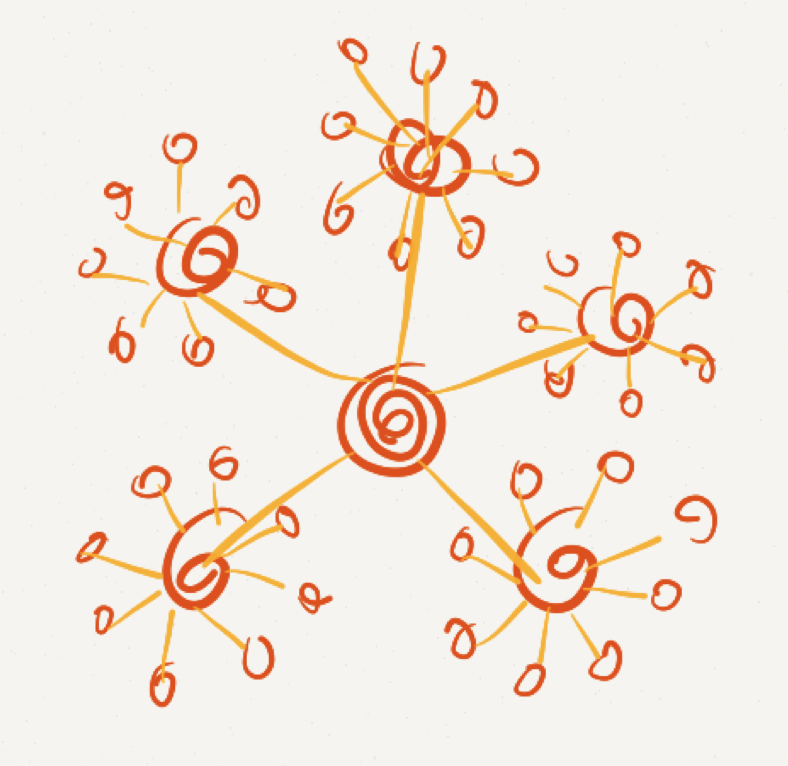
Dandelion modelI first wrote about the hub and spoke model back in summer 2011. Since then I’ve talked to a lot of people about it.

I’m a raving advocate for the model. The cultural changes needed to realise the benefits of digital are only really possible through an integrated approach driven from a single focal point. This is why I’ve often pondered how this model could work at a global scale for an organisation.

Local autonomy is important. I’ve been one of those ‘HQ people’ working with local offices, and now I am part of a ‘local office’ in a global organisation. So I know how important a certain level of independence is. Without this you can’t adapt to local market or community needs, innovation and motivation is stifled, and you risk not being able to capitalise on local opportunities.

Dandelions might just be the answer I was looking for. Jeremiah Owyang posted about social business models recently and described this model as:

Multiple hub & spoke “Dandelion” notice how each business unit may have semi-autonomy with an over arching tie back to a central group.

Reflecting on this – I recognise this model from my current and past workplaces – it’s nothing new. Yet it’s strange how giving a name to something means you can examine and discuss it more easily. Examining it leaves me agreeing with the points Jeremiah makes and adding a few of my own;

  • too much internal comms = noise; but an internal social network delivers the power of discovery and self-filtering.
  • decentralised cross- team working is critical; but it’s tricky for central hubs to empower and be sufficiently in the loop to add value.
  • focus on the bright spots; understanding the strengths and weaknesses of each hub gives strategic opportunities for spreading learning.
  • apples and pears aren’t the same; a common language and frame of reference (eg terminology) makes it easier to identify and share insights.
  • sharing needs to be incentivised; to motivate teams to share it needs to return local results or at least recognition.
  • people trust people; there’s nothing like face to face to build trust and communication, with video meetings there’s no excuse.

what makes a perfect employee?

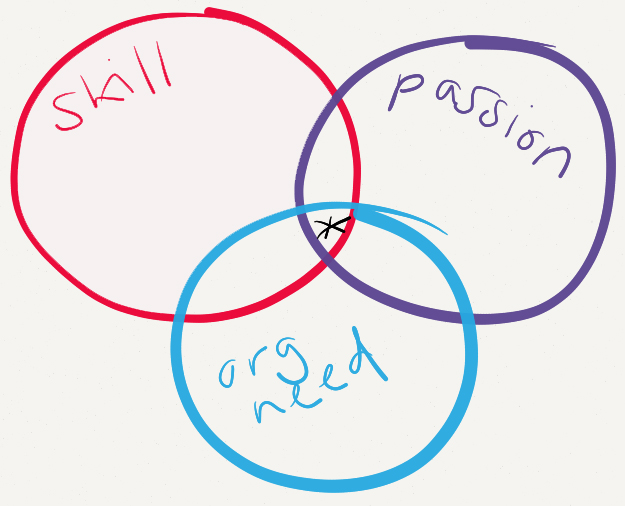
Skill and Passion and Org needToday we had a session at work on well-being and employee engagement. Lots of interesting management theory and practise was shared. At one point during discussion I drew a diagram to explain a point I was making. It seemed to explain things pretty well and someone even said I should write a book 😉

I’m not going to write a book, I imagine someone has already beaten me to it, but I thought it might be useful to share here.

I wanted to explain the delicate balance between skill, passion and organisational need in creating the right mix of team members. It’s particularly relevant to a disruptive industry like digital.

There’s lots of people who have passion for digital, but that doesn’t mean they have the skill/s, or that the organisation needs the particular thing that individual is passionate about. How many times have you had to gently remind people that ‘shiny new’ digital idea in isolation is less likely to get results? Or how many bad videos by keen hobby videographers have you sifted through?

But at the same time; meeting an organisation need and having the right skill is often not helpful unless the passion is also there. While digital is still evolving you need passion in order to keep up with industry changes and / or to have that moment of inspiration that makes your delivery different or better.

being a leader who gets digital

A little while ago I was extremely flattered to be asked to say what I thought every charity leader should know about digital as one of around thirty ‘opinion leaders’. There’s some great content so I thought I’d repost it for anyone who hasn’t yet seen it. I’ve also got some additional thoughts to add to my points (slide 33) so I’ve expanded on them here.

Silos don’t exist externally, don’t let them exist internally

Digital is breaking down walls because of the required ways of working, but the silos shouldn’t have been there in the first place. Recognise the organisational change your digital staff may (or should) be driving and create space for it to happen.

+ Personal responsibility is something every leader strives to embed in their whole team, its good business sense. The same is true with digital, it should be everyone’s responsibility to embrace and explore the opportunities and challenges. Leaving it to the digital staff alone can slow change down and re-enforce siloes. This also means every leader taking the time to explore how to integrate digital into work (and life) too. While existing work approaches are effective they might be bettered… you don’t know what you don’t know.

Your brand has always been what people say about you – you can just see it more

The risks of social media aren’t much bigger than those you already have when a member of staff picks up the phone or knocks on a door. Put the same effort into social media training and guidance and you should be covered.

+ Designing enablers for others to use your brand is the other critical component. Providing easy tools, guides and ways for audiences to use your brand is a proactive way to manage brand. After-all we’re all pretty lazy 😉

Focus on outcome, not sparkle 

An app may be on-trend but you need to do the basics (search, email, website) brilliantly first. It’s a better investment. If you’re not up-to scratch in these areas your other promo activity will be less effective.

+ The opposite side of the coin is also useful to keep in mind (sorry it’s never simple!). Sometimes the sparkly things will get you the outcome you’re looking for. Build a culture that can be experimental at low risk with low effort, at the right time! An example is our UNICEF pinterest experiment, here’s an interview with Beth Kanter about it.

Evidence based decisions rule

Why guess when you can test. Next time you’re agonising over a headline, colour, layout or something else equally subjective remember this. You can test run your work – taking the guessing and the internal politics out of the situation.

+ This is another double-edged sword to be aware of. The old saying is true – if you fail you should try again. So much can influence a result that you need to be sure your test was valid. Too many definitive decisions could limit your options too soon.

Mobile is already here, and it’s not going away

If you’re redesigning your website, emails or anything else, including how you interact in face to face activities – design for mobile devices first. This should also concentrate the mind on ditching any unnecessary-ness.

+ Mobile web is still in evolution. It’s right to invest but worth considering slightly more short-term solutions until the technology starts to settle down more.

building a digital team

So, it’s been a little while since I last posted. Don’t worry I’ve still been living all things digital (twitter and instagram prove that) but I’ve been faced with immense writers block. So this is me breaking it quickly and concisely.

Since I last wrote I’ve been to a few digital events, perhaps too many, many are on personal time so that’s one excuse I’ve been using for my lack of blogging. I’ve also spoken a couple of times on the digital transformation work I’m leading at UNICEF UK so here’s the presentation via slideshare.

the challenge of digital in flux

Recently I met a few colleagues from UNICEF offices all around the world to share experiences and build working relationships. The conversations flowed thick and fast so I’m sure I’ll be drawing on them for blog posts over the coming weeks.

One of the most fascinating things for me was how similar the challenges digital specialists are experiencing.

No matter where the person I spoke with came from, digital appeared to be in a state of flux with confused governance. Digital teams being seen as service delivery and often struggling to get a voice in strategy. And where digital channels are delivering ROI already there were more difficulties in influencing strategically unless someone on the Senior team really understood the future potential beyond the current ROI.

What intrigues me is whether this is just the pattern you see with any media change. You could probably replace the subject in most of these sentences and agree the paragraph still applies. So I’ve been trying to think back to the introduction of the printing press…

I think the key differentiator is where the change stems from. Many have already written that the centre of control is now people powered and organisation structures which are traditionally hierarchical are at odds with this.

This doesn’t explain the lack of understanding of the fact that pinning all your digital activity on an immediate ROI means you’re missing the full potential. I almost (almost almost) think the measurability of digital is its own worst enemy. Printed marketing wasn’t measurable from the start and so brands had to take a risk. With digital being more measurable from the start the line was drawn in a different place.

The pace of change in digital is also a challenge to articulating the potential – some organisations must now have around 10 years worth of web stats but they’ll illustrate the change in digital adoption more than any change in the audience relationship with the brand.

With all my pondering I’m not sure that print didn’t go through the same cycle of change. It’s just the fit with organisation structure was better so it didn’t feel so disruptive.

One final thought… Printing has an ‘end product’ but that stage is just the beginning with digital.
how to build digital literacy in your charity

This week I was lucky enough to be a facilitator at the first CharityComms digital leaders roundtable. There were a few familiar faces but the strategic level promised also attracted many new people too. The topic of the evening was digital literacy in charities.

We spent quality time debating the current state of digital literacy, the impact of this and the approaches being used to build capacity while also handling existing challenges. All a very relevant topic for me personally since my job description tasks me to “mainstream digital at UNICEF UK over a period of 5 years”.

Vicky’s blog sum’s up the key points well so I won’t repeat them here. But I promised to share more information on a few of the capacity building approaches I’ve been taking.

  • Digital competencies framework: a table showing what we expect everyone to be able to do, and then three other levels based on whether you’re external facing or identified as a champion or super-user. This will form part of the organisation’s personal development and recruitment processes in the near future.
  • Training and stimulus sessions: we’ve been hosting external speaker sessions to stimulate interest and learning plus we’re building training programmes based on the competency framework.
  • Internal stakeholder group: with reps from all external facing teams, and key partner teams such as IT and CRM, we meet to shape the strategic direction jointly, and to provide a forum for concerns to be expressed so we’re always listening.
  • Contact management approach: we’ve paired a member of the digital hub with a contact point in another team to ensure a regular dialogue happens. The contact pair discuss plans and opportunities but there’s also capacity building discussions in the regular catch ups.
  • Just doing it: we’ve been modelling the behaviours we want to see by stating ‘digital first’ in project objectives upfront. One example of this is our ownacolour project, it pushed many teams outside of their usual working processes and we’ve all learnt a huge amount from it.

I’ve said before that digital teams needs to be impassioned tutors and coaches and that’s certainly true for my team who are helping to deliver this. Alison, another facilitator from the event, has reaffirmed another perspective for me with her reflection on how digital roles have changed – we also need persuasion and change management skills.