augmented reality summit – summary

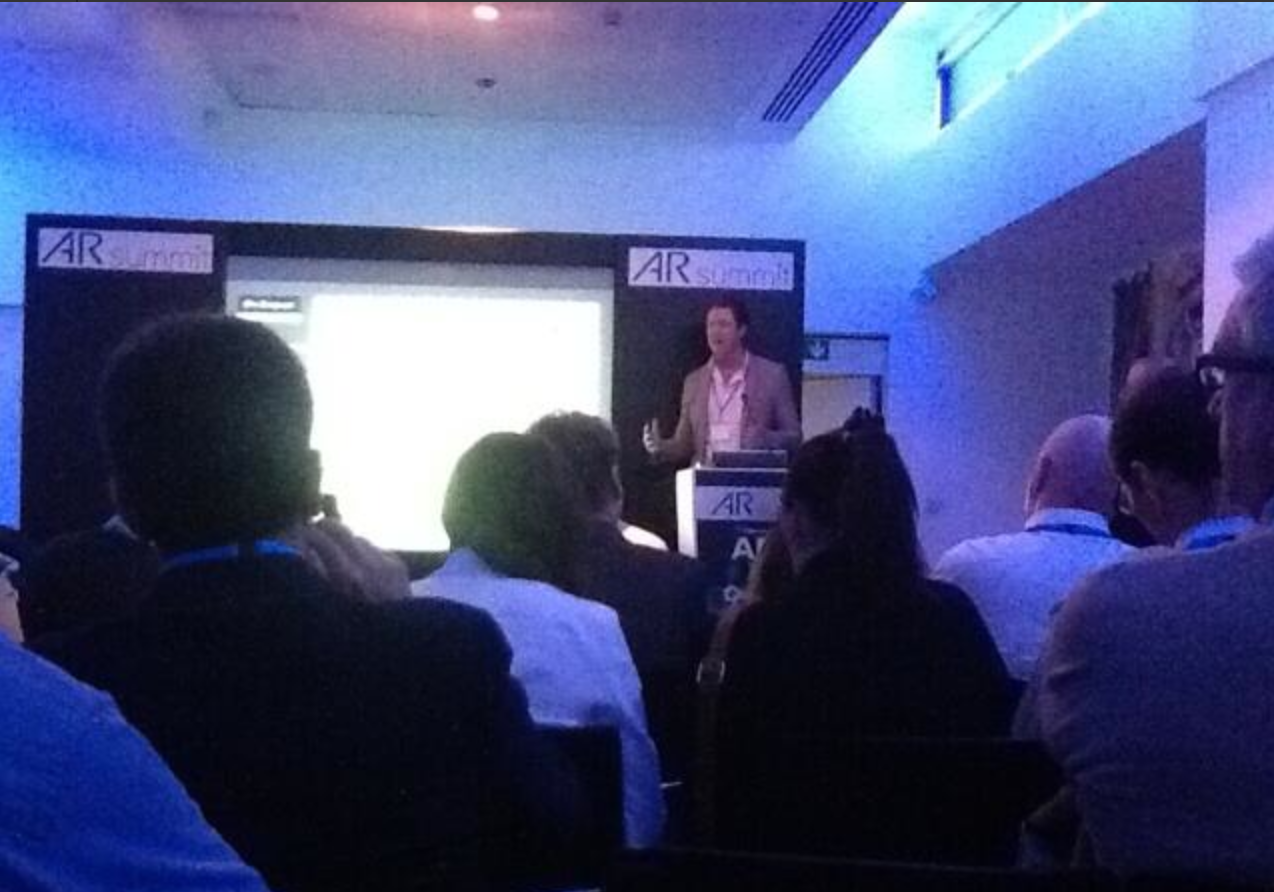
AR Summit 2013This thursday I attended the Augmented Reality Summit, its been going for a few years but this was my first. Here’s a quick summary of my key take aways.

General trend

  • AR has grown from a niche techie interest to something that is viable for consumers in the last year.
  • There is ongoing convergence of wearable technology and AR. Oculus rift and Smart glasses being the obvious examples.
  • Google glass is being viewed as a conversation starter to get the key issues, like privacy, worked through quickly. Smart glasses have been around for a while.
  • QR codes are mostly outdated already as markers – image recognition is widely possible. I’ve never been a fan of QR.
  • AR and future mobile devices have the potential to disrupt the games console market by being just as powerful.
  • The key challenges:
    • battery power; use runs down your battery quickly, but the industry is working on processors and software to help.
    • GPS accuracy
    • interoperability; there’s no standards yet!
    • quality content.

Tips

  • Lighting; accuracy can be affected by light variation but you can always use the flash on a phone to help.
  • Markers; picking a strong image is critical in avoiding temperamental ‘pick-up’ in the AR reading.
  • Apps; custom apps exist at the moment because the off-the-shelf ones give limited interactivity and content options.
  • Aurasma; is relatively widespread in its adoption and has cheap / free options for creating AR triggers. Blippar and Zappar (and others) are yet to offer this.

Case studies

And here’s a tweet summary of the AR Summit in storify.

marketing bootcamp – tough love for leaders

Last week was the first Marketing Academy bootcamp…

What is a marketing bootcamp?

I was lucky enough to be selected from around 600 applicants as one of 30 Marketing Academy scholars. The selection process was rigorous; written application, employer endorsement, showcase piece, telephone interview, four psychometric tests and a panel interview!

There are three bootcamps in the 12 month scholarship. The other elements of the scholarship are mentor meets, lunch and learns, faculty days and coaching.

The bootcamps are two or three intensive days of active learning with all scholars in attendance. This first one was mostly led by @thelivingleader but we also heard from @gailgallie@olibarrett and @petermarkey.

What did I learn?

Lots and lots and lots. Here’s a few of the easy to share bits:

  • Leadership: A real leader is one that develops other leaders. Authenticity is key.
  • Communication: Giving info isn’t the main leadership communication style; other key ones are seeking clarification, supporting, building.
  • Networking: Don’t ask what someone does – find out about them as a person first. You can spot something useful to share by email later.
  • Personal development: Focus on what you want to grow, if you focus on the negatives they will grow.
  • Your vision: If you vocalise your ambitions as if they were already true – it makes them easier to achieve.
  • Confidence: You can’t control how people feel, only how you treat them. So focus on what you give, not what you get.
  • Pull and push: When leading there are times to push, and there’s a moment to switch to pull. If you keep pushing results will diminish.

It’s going to be an amazing year of learning – I’ll try to share it with you along the way.

the future of digital jobs

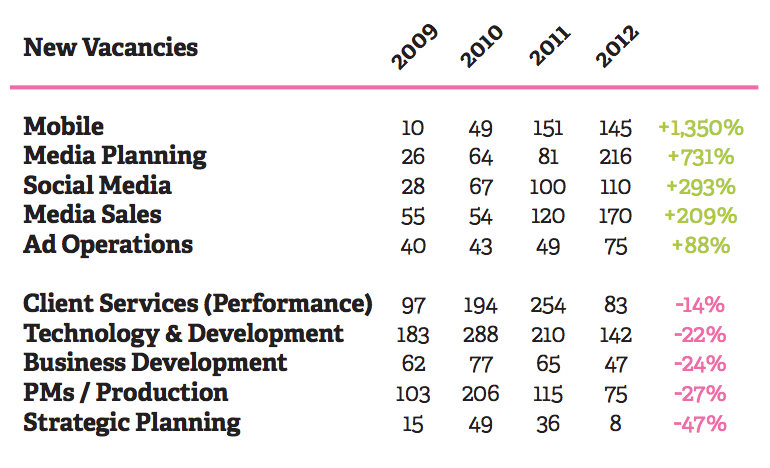
chart courtesy of Propel LondonDiscussing digital transformation often ends with the inevitable question… what happens to the digital roles (your job!) when the transformation is finished?

I’ve written about whether digital team’s will continue to exist before so I won’t go into detail again. But recently I spotted this salary benchmarking report by Propel which I thought gives some useful insights.

I particularly like the chart about new vacancies by role type. What this data makes me think is:

  • there’s more growth in digital marketing roles than ‘back office’ tech and services.
  • specific digital strategy roles are perhaps being subsumed into overall strategy roles.
  • technology is more consumerised and development is getting slightly ‘easier’ to do and project manage with less-specialist roles.

What does it make you think?

digital team structures – hub and spoke or dandelion?

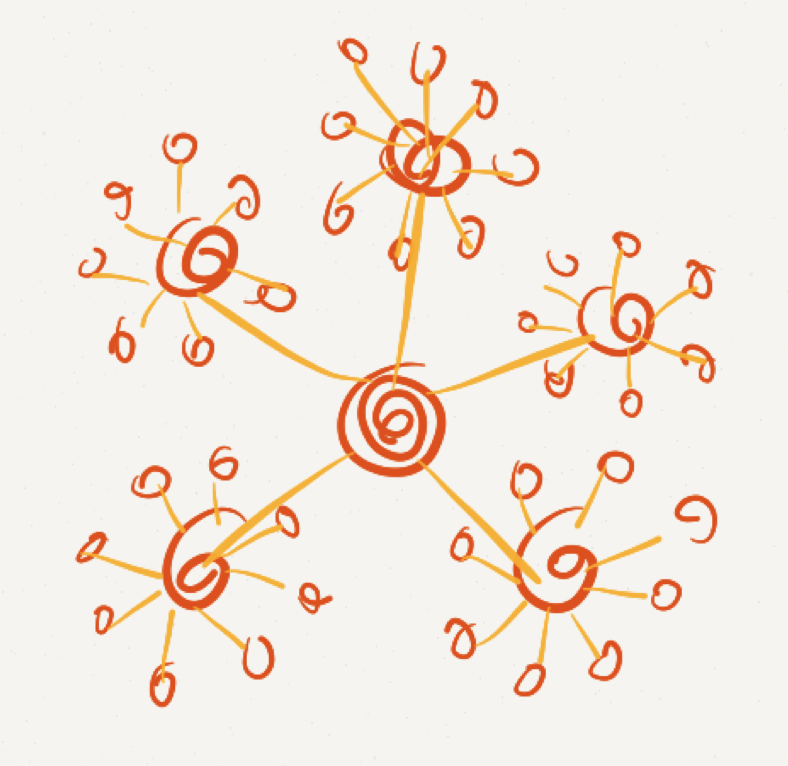
Dandelion modelI first wrote about the hub and spoke model back in summer 2011. Since then I’ve talked to a lot of people about it.

I’m a raving advocate for the model. The cultural changes needed to realise the benefits of digital are only really possible through an integrated approach driven from a single focal point. This is why I’ve often pondered how this model could work at a global scale for an organisation.

Local autonomy is important. I’ve been one of those ‘HQ people’ working with local offices, and now I am part of a ‘local office’ in a global organisation. So I know how important a certain level of independence is. Without this you can’t adapt to local market or community needs, innovation and motivation is stifled, and you risk not being able to capitalise on local opportunities.

Dandelions might just be the answer I was looking for. Jeremiah Owyang posted about social business models recently and described this model as:

Multiple hub & spoke “Dandelion” notice how each business unit may have semi-autonomy with an over arching tie back to a central group.

Reflecting on this – I recognise this model from my current and past workplaces – it’s nothing new. Yet it’s strange how giving a name to something means you can examine and discuss it more easily. Examining it leaves me agreeing with the points Jeremiah makes and adding a few of my own;

  • too much internal comms = noise; but an internal social network delivers the power of discovery and self-filtering.
  • decentralised cross- team working is critical; but it’s tricky for central hubs to empower and be sufficiently in the loop to add value.
  • focus on the bright spots; understanding the strengths and weaknesses of each hub gives strategic opportunities for spreading learning.
  • apples and pears aren’t the same; a common language and frame of reference (eg terminology) makes it easier to identify and share insights.
  • sharing needs to be incentivised; to motivate teams to share it needs to return local results or at least recognition.
  • people trust people; there’s nothing like face to face to build trust and communication, with video meetings there’s no excuse.

twestival two years on

Twestival LogoFor the past few months or so there’s been a worldwide team quietly working away to bring back Twestival. Since 2009, Twestival has raised $1.75 million in support of 286 charities. With this relaunch there’s also a new twist, this time it’s not just a single day of the year, but any day a local organising team chooses.

I got involved a couple of years ago and wrote about my experience and what I thought charities could learn from networked working. This year I’m part of the Global Social and Community team. We’re still using networked approaches but the tools are much better now; Asana for project management, Google calendar for our social rota and Google Docs are the main ones we’re using.

Reflecting on what else has changed in two years I think the most striking thing is that networked collaboration is happening more and feels more normal. But where I’ve seen this most is outside of workplaces.

Technology might have moved on but workplace behaviours are still catching up…


should you outsource your digital technology?

Crown from Seville CathedralThis week I picked up a new phrase (thanks Ian); ‘technology sovereignty’. It’s a nifty way to explain a principle I’ve used in my work ever since I can remember.

Technology Sovereignty = While you might, and probably should in many cases, outsource your technology supply and maintenance needs to a specialist/s – you should not hand over complete control. 

There’s obvious downsides if you do hand over your sovereignty; reduced ability to negotiate price or options, reduced flexibility, and more.  You could even find yourself in the terrible position I once experienced.

At one workplace I inherited a setup where the website CMS, development contract and hosting were all with one supplier – then the company went into administration due to a hostile merger. I was forced to move suppliers without any real choice, unless you consider months of downtime a choice. The new supplier had significantly higher prices and no understanding of the CMS (among other things).

I learnt a lot from that experience. One thing I realised is how much I’ve leaned on my computer science background to help me at work. The benefit of being able to challenge and co-design solutions with suppliers has definitely helped me to keep more control and avoid all kinds of issues.

Recently someone told me they didn’t feel they should need to know this stuff to do their digital job. In reply I talked about car maintenance. I was taught about how a car engine worked in school. It didn’t mean I could build an engine – but I could describe how it should work. It’s meant I can challenge car mechanics where needed.

So should you outsource your technology?
Yes, at least in part. Outsourcing often means you can benefit from economies of scale that come with a supplier or platform having multiple clients. But make sure you know what you’re talking about and avoid having a single point of failure unless it’s an area where failure doesn’t matter.

practical mobile tips for non-profits and charities

I was one of the keynote speakers at Media Trust’s Go Mobile conference this week, a few people have asked for my slides and notes so here they are…

Notes:

Mobile is here

You have to think mobile for all of the experiences you are designing. It’s not going away and it’s not ‘on the horizon’, its well and truly here.

But it’s still evolving

Mobile compatibility is still not entirely standardised, it’s a bit like the www in the 90’s. Adoption of different devices is also changing rapidly. For example, in just the last year the UNICEF UK website has seen a big growth in iPad that has caught it up with iPhones, we also saw Google Nexus 7 appear as well as others.

Case: UNICEF UK Mobile Website

To make sure we had a mobile compatible site as quickly as possible we launched an interim mobile website of just a few key pages and the donation funnel. We’re working on optimising the whole of the site. To keep costs lower and give us increased technology flexibility we’re using separate ‘layers of tech’ to do the transformation rather than having a fully responsive site (for now).

Case: UNICEF Sweden website

Our UNICEF Sweden office, on the other hand, have created a fully responsive website. They were on the brink of a full website rebuild so it made sense to invest now and go ‘mobile first’. The site is designed for smartphones first and PC desktops last. They had to make some hard decisions on how to streamline content.

Forget about ‘mobile’

It’s easy to get obsessed about mobile devices, really what this change means is a change of behaviours. Remember behaviour first when you are designing user experiences. People are now using multiple devices, we don’t live in single screen households.

Time of day

This graph demonstrates a clear difference in behaviour that mobile has created. UNICEF UK non-mobile traffic peaks during working hours while traffic from mobile devices is consistent throughout the day, even into the early hours. This pattern is important when you think about how people are interacting with your brand.

Case: UNICEF UK Speak Up for Children

I’ve learnt the behaviour lesson. We (with an amazing group of partners) did a brilliant mobile campaign called Speak Up for Children, it was a great success in the end, but we failed at first. The original concept was to create the biggest voice petition in the world. It seemed to make sense that a mobile campaign should use the voice feature of your mobile phone.

We quickly learned that very few people wanted to interact this way, it was just a bit too intrusive / embarrassing. So we paused the campaign and replaced the petition with a simple email address entry field.

Case: Syria Emergency

We also know that SMS giving is really effective. It enables the immediate emotional response of a supporter who wants to help, it also gets funds for emergencies quickly. We even include the SMS giving number in search adword campaigns. You should be prepared for SMS giving no matter what charity you are.

Apps are hard

Finding a concept that works as an app is hard. UNICEF offices around the world have tried and success has been limited. You need an app that fits with an individual’s life, if you wouldn’t download it – don’t build it.

When I worked at the British Heart Foundation we created a recipe finder app, it worked because it was something people could use repeatedly and it fitted with our brand.

Email is important

Increasingly, email is consumed on mobile. If you have an email marketing programme or email newsletter it should be compatible with mobile now. Even if you have to create plain text emails, it’s better than emails that don’t work on a mobile.

It can be easy (sort of)

If you have very limited resources it can be very difficult to go mobile. But there are lots of platforms which are now mobile compatible which you could design your experience around. For example; using twitter, facebook and justgiving could give you a campaign experience which is mobile compatible without you needing to convert your own website for a bit longer.

And that was it!

15 mins really isn’t very long to talk about mobile. I didn’t even touch on UNICEF use of mobile in the field, there’s a bit about that in this innovation presentation.
what makes a perfect employee?

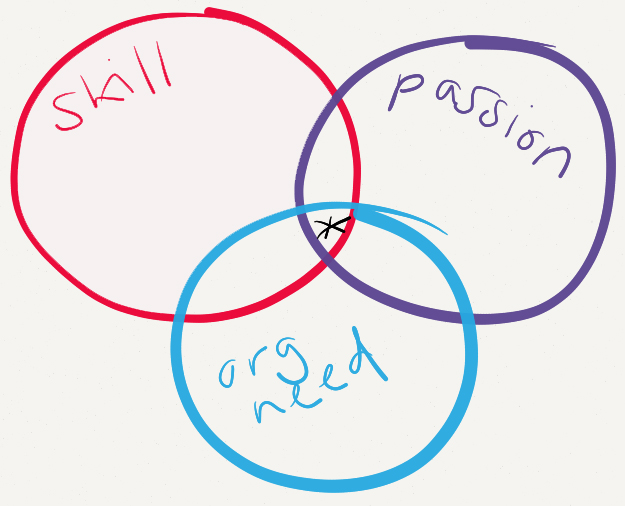
Skill and Passion and Org needToday we had a session at work on well-being and employee engagement. Lots of interesting management theory and practise was shared. At one point during discussion I drew a diagram to explain a point I was making. It seemed to explain things pretty well and someone even said I should write a book 😉

I’m not going to write a book, I imagine someone has already beaten me to it, but I thought it might be useful to share here.

I wanted to explain the delicate balance between skill, passion and organisational need in creating the right mix of team members. It’s particularly relevant to a disruptive industry like digital.

There’s lots of people who have passion for digital, but that doesn’t mean they have the skill/s, or that the organisation needs the particular thing that individual is passionate about. How many times have you had to gently remind people that ‘shiny new’ digital idea in isolation is less likely to get results? Or how many bad videos by keen hobby videographers have you sifted through?

But at the same time; meeting an organisation need and having the right skill is often not helpful unless the passion is also there. While digital is still evolving you need passion in order to keep up with industry changes and / or to have that moment of inspiration that makes your delivery different or better.

The night before barcampnfp

barcampnfp Oct 2012I’ve been involved in barcampnfp for about a year and a half now, once as a helper and twice as the London lead organiser. Every time I learn something new, or more accurately, lots of new things.

There’s something special about an unconference format which means you learn something every time no matter whether you’re a newbie or old hand. Often it’s something I didn’t even know I wasn’t aware of. That’s why I’m really excited about tomorrow, not for what I know is going to happen but what I don’t know.

We’ve got some brilliant people on the participants list and lots of plotting of ideas for sessions already happening on the hashtag.

Watch this space #barcampnfp and hopefully our live notes will work too: bit.ly/bcnfpnotes

being a leader who gets digital

A little while ago I was extremely flattered to be asked to say what I thought every charity leader should know about digital as one of around thirty ‘opinion leaders’. There’s some great content so I thought I’d repost it for anyone who hasn’t yet seen it. I’ve also got some additional thoughts to add to my points (slide 33) so I’ve expanded on them here.

Silos don’t exist externally, don’t let them exist internally

Digital is breaking down walls because of the required ways of working, but the silos shouldn’t have been there in the first place. Recognise the organisational change your digital staff may (or should) be driving and create space for it to happen.

+ Personal responsibility is something every leader strives to embed in their whole team, its good business sense. The same is true with digital, it should be everyone’s responsibility to embrace and explore the opportunities and challenges. Leaving it to the digital staff alone can slow change down and re-enforce siloes. This also means every leader taking the time to explore how to integrate digital into work (and life) too. While existing work approaches are effective they might be bettered… you don’t know what you don’t know.

Your brand has always been what people say about you – you can just see it more

The risks of social media aren’t much bigger than those you already have when a member of staff picks up the phone or knocks on a door. Put the same effort into social media training and guidance and you should be covered.

+ Designing enablers for others to use your brand is the other critical component. Providing easy tools, guides and ways for audiences to use your brand is a proactive way to manage brand. After-all we’re all pretty lazy 😉

Focus on outcome, not sparkle 

An app may be on-trend but you need to do the basics (search, email, website) brilliantly first. It’s a better investment. If you’re not up-to scratch in these areas your other promo activity will be less effective.

+ The opposite side of the coin is also useful to keep in mind (sorry it’s never simple!). Sometimes the sparkly things will get you the outcome you’re looking for. Build a culture that can be experimental at low risk with low effort, at the right time! An example is our UNICEF pinterest experiment, here’s an interview with Beth Kanter about it.

Evidence based decisions rule

Why guess when you can test. Next time you’re agonising over a headline, colour, layout or something else equally subjective remember this. You can test run your work – taking the guessing and the internal politics out of the situation.

+ This is another double-edged sword to be aware of. The old saying is true – if you fail you should try again. So much can influence a result that you need to be sure your test was valid. Too many definitive decisions could limit your options too soon.

Mobile is already here, and it’s not going away

If you’re redesigning your website, emails or anything else, including how you interact in face to face activities – design for mobile devices first. This should also concentrate the mind on ditching any unnecessary-ness.

+ Mobile web is still in evolution. It’s right to invest but worth considering slightly more short-term solutions until the technology starts to settle down more.